Mathematics REUs as a Freshman
Like far too many other optimistic math majors, I applied to a large number of math REUs for the summer 2026 cycle, hoping to get into something. Luckily, I did get into something. In this post, I'm going to talk about my experiences applying to REUs (including things like how many I applied to, when I started writing applications, etc.), as well as some resources I used and advice I've gathered. It will also include a (hopefully expanding) list of successful REU application writing materials to serve as a reference. However, much of what is said here should be taken with a pea-size grain of salt, since, as a freshman, there is and likely was a significant bias against me in REU selection. Of course, I am also not an expert or authority on this subject. I will include many of the excellent resources that I utilized during this application season and encourage feedback. It is very likely that the advice I give this year will change in subsequent years.
For those using this post as a guide, it is important to distinguish between the domestic US applicant attending a US institution, the international applicant attending a US institution, and the international applicant attending a non-US institution. If you are in the former category, this post applies to you—read on. If you are in one of the latter categories, an REU is not necessarily what you are searching for, because REUs generally only fund US citizens, permanent residents, or nationals. If you want to do math research, your best chances are at international REUs/programs that aren't explicitly US-affiliated or funded. I'll discuss this at the bottom.
My profile and what I believe worked well
Below is a flowchart for my REU results in the 2026 cycle, made here.
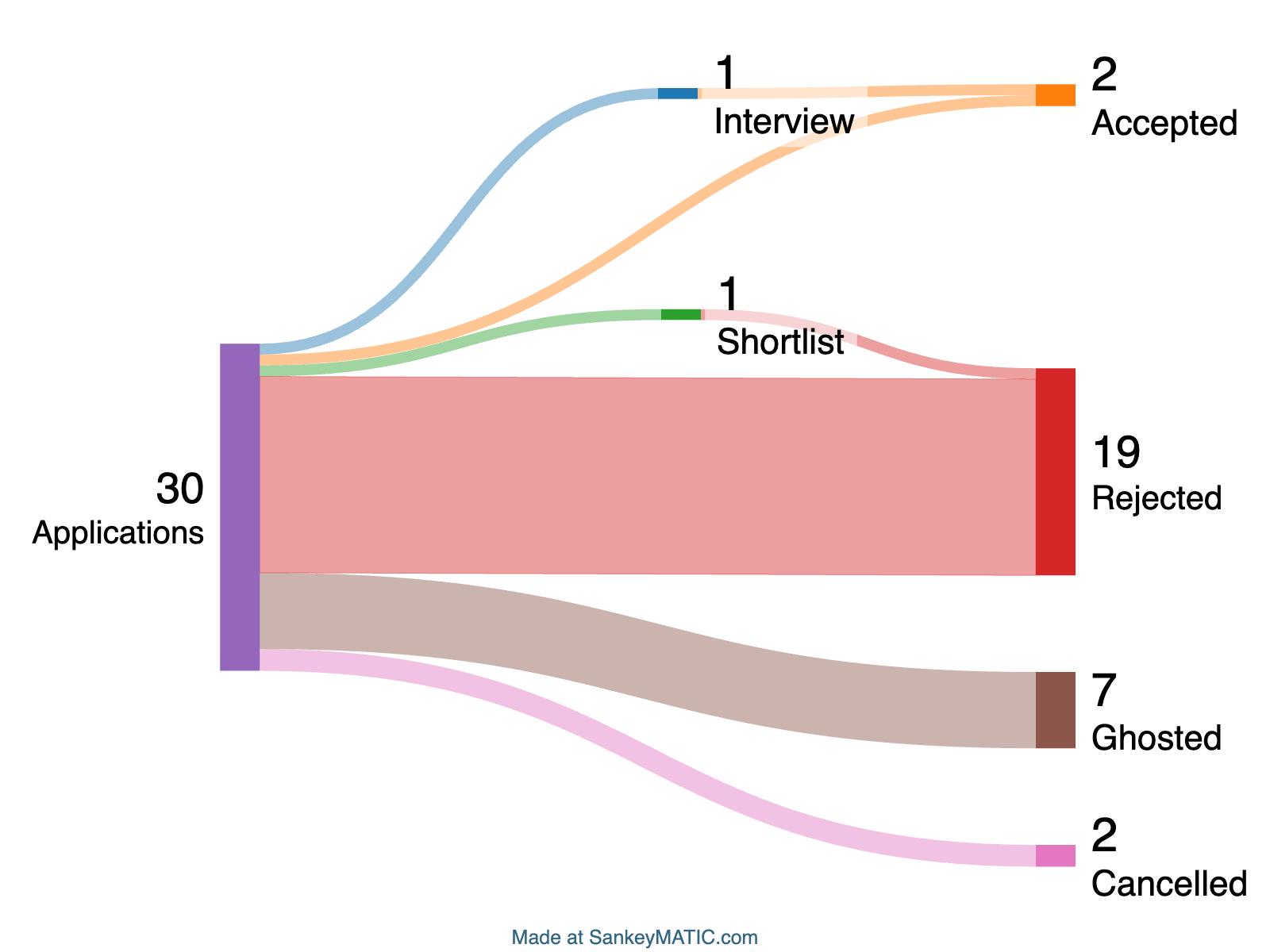
This cycle, I applied to a total of 30 math REUs. The vast majority were pure math REUs, though I applied to a small number of "applied" math REUs as well.
I was accepted to the Einstein Institute of Mathematics HUJI REU (number theory) and the Oklahoma State University Polynomials REU. I was also shortlisted from the USC Palmetto Number Theory REU, but ultimately committed to the Einstein Institute REU.
I began writing my application materials back in December during my winter break. Beginning this early was ultimately what allowed me to submit so many applications, and it is probably the first piece of advice that is objectively true: start early. When applying, it is beneficial to organize the REUs you're applying to in a spreadsheet so you can keep track of references, application deadlines, other dates, and eventually status.
My academic stats (up to February 2026)
- School: University of North Carolina at Chapel Hill (R1, T30)
- Primary Major: Mathematics
- Class Standing: Freshman
- GPA: 3.5
- Coursework: Analysis I, Advanced Linear Algebra, Algebraic Geometry, Abstract Algebra (Undergraduate); Topology (Undergraduate/Graduate)
I submitted my CV when I had the chance. I was worried somewhat about my GPA when applying, but a brief and good explanation can almost always remove doubt—I also had some leeway because it was after my first semester of freshman year.
I believe there were three factors that made me a strong candidate: (1) my past research experience, (2) my writing materials, and (3) my coursework. For (1), I had conducted research in high school (which was fortunately very research-oriented) and expanded upon it in my first semester at university, which gave me an idea of what I wanted to focus on. I did not attempt to conduct math research during my first semester, but I did complete a directed reading program (DRP), which I highly recommend both as a CV item and a great chance to learn math you wouldn't learn otherwise. For (2), I read a number of writing samples beforehand and developed a good general template for most of my REU applications. I customized my writing to each REU in at least one paragraph, and maintained a confident but humble tone. From what I've seen, underselling yourself won't be seen as being humble, but rather lack of self confidence and ambition. Lastly, for (3), I took the most difficult and interesting courses I could. While performing well is important, I tried to take core courses that would be useful in a math REU. Taking a specific course like algebraic geometry also gave me an interesting skill that could be useful in an REU that dealt with that topic in particular.
Now moving on to the general advice that is specific to freshmen.
How do I find REUs?
After my first semester, I was wondering: what even is an REU application like? When I searched online at the beginning of winter break, I was immediately overwhelmed by the number of seemingly important things (I was also unable to find a resource that informed the freshman demographic, hence why I wanted to write this post). First, REUs aren't only in math, and nearly every field has them, from neuroscience to engineering to nuclear physics to even organization-specific programs like NASA, JPL, LIGO, SETI, and even more. The social sciences also have some representation, though this wasn't the focus of my applications so I am less informed in that area. It can be overwhelming how much there is, but luckily, math REUs are well-documented.
The first "resource" I found was the subreddit r/REU. Like many other subreddits and forums relating to academia, r/REU contains a lot of misinformation and irrelevant generalization. For some reason, I thought r/REU was only for math programs, but I quickly learned that I was wrong when I wrote a comment and received advice that was completely useless. Fortunately, math REUs do have significant representation in the subreddit, and there are some threads from past application years (Math REU 2026 Thread, Math REU 2025 Thread, Math REU 2024 Thread; more results are buried somewhere in the subreddit). I interpreted the subreddit as more of a gauge of similar applicants, but I took most advice with a grain of salt. It's great to see a lot of motivated people in one place desperate for research experience and something cool-looking on a CV (me included). The subreddit is essentially a combination of people complaining about the NSF ETAP application portal to a very high degree, a place for skeptics with impostor syndrome to be consoled, and a daily barrage of people asking "what's the difference between a cover letter and a statement of interest?" I'll give some advice on that last point later, but overall, the subreddit was a great companion throughout the application process (though it occasionally caused self-doubt), and you might meet some cool people there too!
I think the beautiful thing about REUs is that anyone from any institution will be applying. Students from Yale, Columbia, Harvard, MIT, Stanford, UC Berkeley, UNC (me!), and many other prestigious schools, are competing for few positions at highly competitive math REUs at seemingly "no-name" universities like California State University Chico or University of Minnesota Duluth (which, as we'll talk about later, is probably less productive to apply to if you attend a non-T10 university in the US).
The first place to find math REUs is Steve Butler's (Iowa State University) Math REU Programs website. For the past few years, Steve Butler and some other people (not sure who) have maintained a nearly exhaustive list of math REUs that are running each summer. This includes applied and pure math REUs, as well as some institutional and/or industrial internships at places such as JPL or the NSA. For 2026, just under 200 REUs were listed (note that when I say "REU," I'm including many SURFS and non-NSF funded programs—which are institution-specific and may be funded alternatively—since among math summer research programs, most will be REUs anyway). I encourage checking out the rest of that website as it contains helpful advice (albeit a little outdated) about REU applications.
A non-exhaustive list of places to find REUs includes a search query on NSF, reufinder.com, NSF ETAP, mathprograms.org, and the American Mathematical Society (AMS) (which also features an incredibly useful blog post about applying to math REUs).
What is the culture of math REUs and where are applications submitted?
In the realm of math REUs, the institution at which an REU takes place is essentially irrelevant to the supposed "prestige" of a program. There aren't many exceptions; math REUs can be divided into "tiers." Personally I see there being 3 tiers: the first consists of the long-standing REUs (such as Duluth, Williams SMALL, UChicago, Baruch, Twin Cities, Rutgers DIMACS etc.), the second consists of not-as-long-standing yet very well-known REUs (such as UMich, IU Bloomington, Yale SUMRY, MIT MSRP, Clemson, ICERM, California State San Bernardino etc.), and the third consists of newer and perhaps more underclassmen-friendly REUs (such as Haverford, Ohio State OSUIM, Tufts VERSEIM, Michigan State SUREIM, USC Palmetto, Oklahoma State University etc.). However, getting into any REU at all is already a signifier of significant success, as there are just so many applicants. International REUs fall in their own category and are listed below.
Here are some (not so fun) facts. Math REU acceptance rates are typically less than 5%, and this statistic holds even for "lower-tier" programs. For example, for the 2026 cycle, Baruch accepted 12/800 students, ICERM accepted 18/600 students, SMALL accepted 40/700 students, and so on. The most notable anomaly is probably the Duluth REU, which accepted 9/347 students, which, even with its 2.5% acceptance rate, largely accepts Ivy League and Stanford/MIT students as can be seen from its past participants. I recommend reconsidering applying unless you attend one of those schools.
Most math REU applications are concentrated on mathprograms.org and NSF ETAP. The lack of standardization in REU applications is something that certainly requires reform, but who knows when that will happen. ETAP is a step in the right direction, but the website is incredibly glitchy and has garnered quite a bit of hate. Applications require no fee, so apply to as many as you want, with one caveat—apply largely to programs you would actually be interested in contributing to.
With this, I recommend creating your own spreadsheet to keep track of programs you're applying to, due dates, program duration, any individual comments you have about a program, location, and eventually your application status.
Recommendations and references
Reading through many of the resources linked to this post, most of the standard advice holds for freshmen. Freshmen, however, are systematically disadvantaged: they have fewer advanced math classes, they likely have little to no math research experience, and they will lack strong recommendations. In my case, I was lucky enough to receive good recommendations from a high school professor who was familiar with my research and a professor connection at UofSC. I eventually obtained a recommendation from my algebraic geometry professor at UNC in the second semester, and I used that recommendation for a few applications. I recommend trying to get at least one recommendation from a professor in a class you took first semester, or attempt to get one in the second semester as soon as possible. This can be difficult, especially since connections are made over multiple semesters rather than 4 weeks of class, but it's always worth a shot—some professors are understanding and reward ambition.
I've seen recommender status classified as high school < TA < graduate student < post-doc < professor < research advisor < Nobel/Fields winner (the last one is a joke). While this classification is essentially true, it's important to remember that a contextual recommendation from a high school teacher (e.g. one that can talk deeply about your experience and maybe unique approach/passion for math) is infinitely more valuable than a recommendation from a professor who doesn't know you that well. This comparison can be made anywhere across the classification. In my case, I especially utilized my high school professor connection as it was already strong. If I didn't have a high school recommendation, I would have considered summer program mentors, any form of research advisor, and possibly even non-math professors (which, while not great, could showcase research potential and critical thinking that is better than not having a recommendation).
Here are some things I was confused by that weren't actually that confusing. Most programs will state explicitly how many recommendations they want and how you should submit them. The standard requirement is 2, and only a few programs will ask for 1 or 3. 3 is typically optional, and only include a third if it can genuinely improve your application (meaning, if you do get a recommendation from a non-math professor, don't). On mathprograms.org, under "Portfolio" and "References" you can add recommenders, as well as fill out the general cover sheet. On NSF ETAP, for students who filled out the Common Application (college application platform for American universities), recommenders are added very similarly and can be customized to each application. For some math REUs, you have to ask your recommenders to email their recommendations to a program directly. As mentioned above, keeping a spreadsheet where you can list which recommenders you use for a given application can be very logistically helpful.
REU writing materials
First, I recommend staying organized. I firmly believe writing all application materials in LaTeX is the best choice (I recommend Overleaf). It just looks more professional to me. Store completed documents locally and keep all your application materials for each program in one place, and keep a master copy of your CV, transcript, and whatever else. Some programs will ask for "Relevant Programming Experience" or "List of Math Courses with Grades." These are basically redundant, but if it is asked for, it must be provided, so I just made a document and listed those. Other programs might have program-specific questions (particularly the Summer Leadership Alliance SREIP), and those should be answered accordingly.
When I first started looking over required materials, 3 main categories emerged immediately: the personal statement, statement of interest, and cover letter. I've seen these compared to materials needed for graduate school applications, and this is a fair assessment. For grad school, it is not uncommon to have a cover letter, as well as one of the former two. Most math REU applications require either the personal statement or statement of interest, and only a few required a cover letter in addition or only required the cover letter. It's important to follow the directions clearly and know exactly what a program wants you to submit.
What's the difference between these 3 categories?
A personal statement (PS) should be at most two pages (LaTeX, 1 in margins, single space). The goal of the personal statement is a little bit different. You still have to introduce yourself and state the project/topic/mentor you're interested in working with, but you have the freedom to be more eloquent and introduce more motivations for what made you interested in a specific topic. I've seen some people write personal statements like in college applications where they talk about their romantic journey toward loving math, but this is a serious mistake: a personal statement should remain professional, and the goal is to describe your reasons for wanting to learn or research something. Committees know that you love math (I love math (though I sometimes hate it)), so why waste breath saying that you love it? Just be direct. This is where you can diverge from your CV a little bit and talk more about what you gained from each experience, and how you're excited to apply your experience to an REU. This is also the best place to explain your near-future goals and possibly less-than-adequate grades, though these shouldn't be the focus. I made a template of my personal statement that I modified to produce either of the other two documents.
A statement of interest (SOI) does have real meaning when applying to graduate school, but for math REU applications, it functions nearly identically to a personal statement, though it should expand more on the "near-future goals" part.
A cover letter should be at most one page (LaTeX, 1 in margins, single space). The goal of the cover letter should be to introduce yourself, state the project/topic/mentor you're interested in working with, describe your past experiences and qualifications, and evaluate your personal fit for a program. The first cover letter I wrote was for FUSRP, and it was dreadful because I didn't know how to write a cover letter. It should be straight to the point, and you don't need to mention any stories or motivations—just be clear and market yourself. Another important thing would be to briefly state future career interests, for instance graduate school, research, etc.
I have seen the ranking of the importance of REU materials differ widely. For the general applicant: GPA < research experience < coursework < essays < letters. For the freshman applicant: research experience < GPA < essays < coursework < letters. For more advanced applicants: GPA < essays < coursework = research experience < letters. However, to distinguish yourself no matter your year, it is important to state exactly why a program needs you and what specifically you can gain by attending, i.e. fit. Many applicants will claim to have good fit, but if there is something that sets you apart—say, you've done a project connected to the REU research topic or done significant reading on a specific area—then mention it.
That's everything! As a freshman, I believe there is no harm in writing many, many applications and reusing the same personal statement (of course, with tweaks). I've seen that being specific and more tailored to specific programs is useful for sophomores (second years) and upperclassmen, and thus fewer applications should be submitted, but this is wishful thinking for freshmen who are already at a significant disadvantage. I made the mistake of stating that I was a freshman in the first line of every single cover letter/PS/SOI, and I think stating that also created undesired bias, so don't do that!
As a freshman, it can be difficult to market yourself if you don't have much prior research experience. Some programs actually prefer this, and in the PS/SOI, it should be emphasized how your coursework and specific interests make it so that you really need a specific program. No matter how good you are, if you can express why a program needs you and vice versa, then you'll likely find success. Don't oversell yourself, but don't be afraid to be confident in your writing when describing what you want and why you want it.
Some incredible resources for writing REU applications can be listed as follows: Lena Ji (includes some writing samples from successful applications that I found to be very useful and influential for the style of writing), MAPS at UVA (I discovered this more recently, but it includes advice from past REU students and more resources), and many more can be found on Google (though these are the ones I found most helpful).
To be a useful resource for future applicants, below are some examples of successful REU writing pieces. These should hopefully serve as useful models for writing REU applications, but should not be taken as the standard.
- Matias Relyea (UNC Chapel Hill): Einstein Institute of Mathematics REU 2026 (number theory) [statement of interest]
- Peyton Jackson (Columbia University): UNCG Computational Statistics REU 2026 (topological data analysis) [personal statement]
(If you are just visiting, hi! If you were accepted to a math REU and would like to help future applicants, you could help build this list by emailing me with your successful REU writing materials. If you are interested (even anonymous additions are invaluable!), email hyanlong [at] unc [dot] edu)
For international applicants
Before anything, it is imperative to note that in general, international students are not eligible for math REU funding, even those attending a US institution. This applies to students who have an F-1 visa as well. The majority of math REUs (and REUs in general) require US citizenship and permanent residence. However, some REUs allows international students at US institutions to participate and receive funding, and international applicants are absolutely encouraged to apply. For these REUs, while funding is often available, it might be more competitive due to the prioritisation of domestic US applicants. From freshmen international applicants, this is especially true. An REU's website will specify exactly what they are looking for and whether they fund international applicants at US universities. Some examples of math REUs that accept international applicants residing at US institutions include UCLA RIPS Los Angeles, Brown ICERM (spots are limited), IAS Park City Mathematics Institute (accepts students at non-US institutions as well), and so on. To reiterate, in general, REUs funded by the NSF are not available to international applicants not residing at a US institution.
Many high quality REUs are not funded by the NSF, and I cannot recommend these enough: Fields Undergraduate Summer Research Program (FUSRP), Bernoulli Young Researchers in Mathematics Program, Einstein Institute of Mathematics, Aalto University, and are just a few, depending on the year. These programs are available to students attending any university, regardless of citizenship—for freshmen, these will be incredibly competitive, as they focus on students who have taken more advanced coursework, possibly including graduate coursework. The one unique program that I describe below in a little more detail is the Polymath Jr. REU, which is an equally valuable opportunity and open to anyone anywhere.
Other advice
I found that I was far too stressed when writing REU applications, and this slightly impacted my performance in the spring semester. Yes, REU applications are stressful, but they shouldn't be your primary focus. In a way, I let REUs dictate what was on my mind half the time, and this was pretty unhealthy. If I have learned anything from college applications, it's that letting something like this control your life is not a good idea. Research potential is built on knowledge, and if REUs become more important than coursework in your mind, then you are undermining your own potential for REUs in subsequent application years and good research experiences in the future. I wish I had learned this earlier. Especially as a freshman, it should be more relaxed.
Aside from this, here are some facts about decisions. Due to recent events, and events that will likely persist for at least a few more years, many math REUs knew nothing about NSF funding and a couple were cancelled because of this. This is largely due to funding cuts.
Decisions for math REUs come out in waves: 1st wave, 2nd wave, and theoretically there are \( n\in\mathbb{Z} \) waves, but really every applicant is just on a very long waitlist. Some successful applicants to highly competitive programs receive decisions within a few days of the application deadline. Most receive decisions within a month of the deadline. If a decision isn't received by mid-March for early-to-mid February deadline applications, it is safe to assume that you were placed either on a short list, medium list, or the "infinitely long list" (which will likely result in rejection). Some programs do ghost, and while this is annoying, I suppose it is realistic. For freshmen applicants in particular, not receiving a decision for a while is normal, mostly because it is unlikely to be accepted immediately—if acceptance is a possibility, it is more likely to be placed on a short list or medium list, which takes a while to fully exhaust as other applicants claim and deny offers to other REUs. Patience is key. If a decision isn't received by, say, late April, this is a sign of rejection from most programs. Sending a brief email to a program to ask for a decision for "closure" isn't disrespectful at all, but don't do it too early.
Not getting an REU isn't the end of the world as a freshman. Applying this early shows a lot of initiative, and if anything, it is an opportunity to gain graduate school application writing experience. Remaining productive over the summer is very important in math, so doing independent reading, attending summer courses, doing an independent research course, and directed reading are all very productive. In fact I plan on doing independent reading over the summer anyway to supplement my REU and prepare for my courses next semester. One program that is mentioned on the websites of a lot of math REUs is the Polymath Jr. REU. Polymath Jr. is an online program that accepts most applicants with basic proof-writing and rigorous coursework (read more about it on the website), and it's sort of a "you get out of it what you put in" program. I'm not too familiar with details, but this is an excellent backup to remain productive over the summer, and it still looks great on a CV, especially as a freshman. The only difference is that it does not provide a stipend, but learning a ton of cool math is a great opportunity. Since Polymath Jr. is online, it does not care about citizenship—all non-US students should apply too as this is another great opportunity.
Anyway, this is my experience as a freshman applicant, and some advice that I gathered from people and resources online. Hopefully it will be useful. I'm always open to any suggestions or feedback!
(Last updated 20 April, 2026)